Medical AI in German Healthcare
Claude, ChatGPT and other large language models are already part of everyday clinical practice. Trustworthy Medical AI, however, has not yet reached care at scale. A new whitepaper sets out what has to change and who has to act.
On 24 November 2026, a cross-sector think tank presented An Evidence-to-Care Journey for Medical AI in the German Healthcare System at Bitkom's digital health conference in Berlin. Honic Co-CEO and Co-Founder Dr. Henrik Matthies co-initiated the think tank in early 2026 together with Prof. Ariel Dora Stern (HPI), Dr. Sievert Weiss (Amboss) and Nicolas X. Weber (Novartis Germany). The whitepaper makes 14 recommendations across five phases, from access to medical evidence through to measuring impact in everyday care.
Shadow AI is a symptom, not misconduct
Many physicians and other healthcare professionals use freely available AI tools. These tools were not built for clinical use and run outside any governance. The think tank calls this "shadow AI" and treats it as a symptom: trustworthy alternatives are reaching healthcare delivery too slowly.
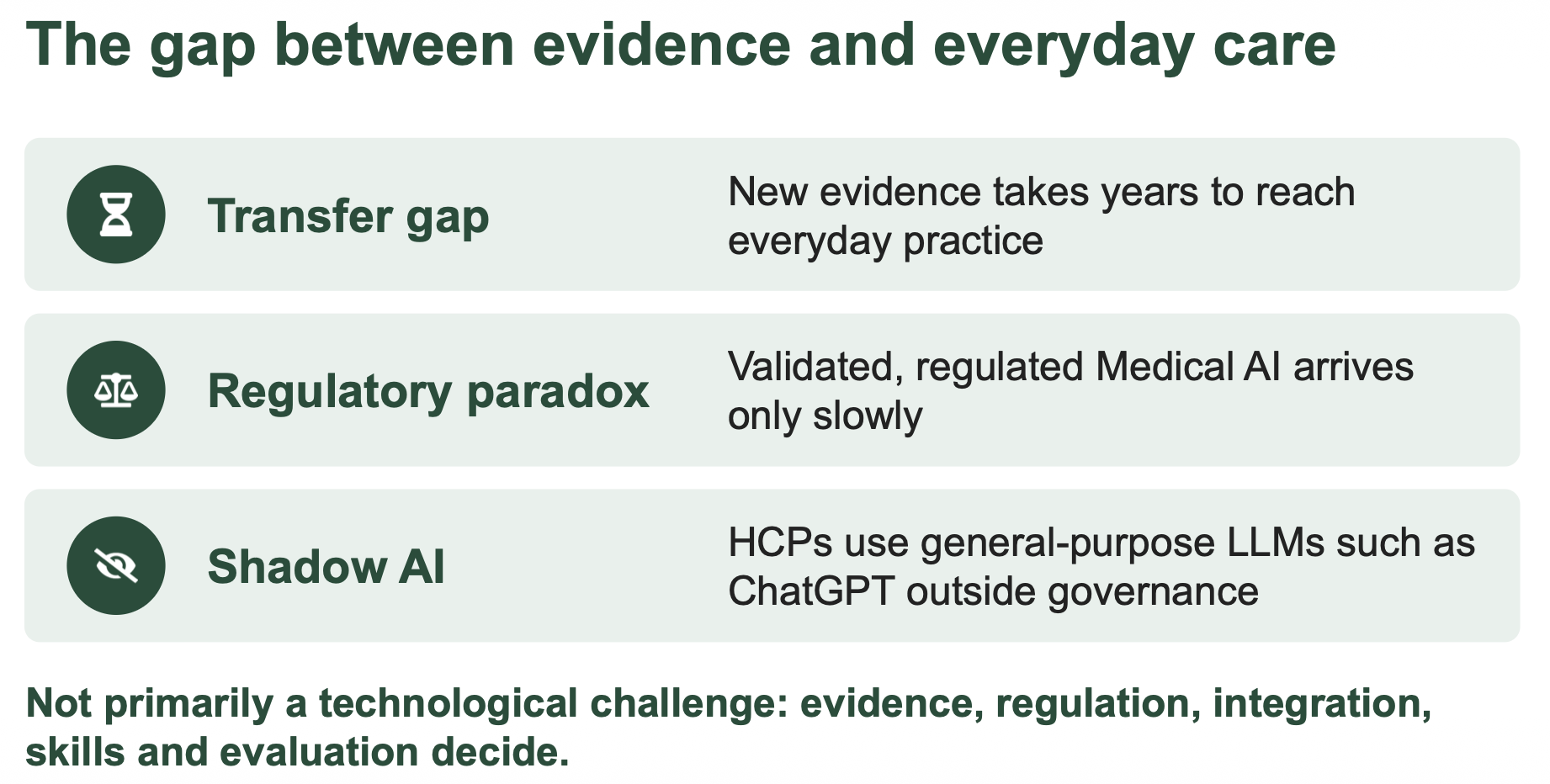
The whitepaper traces that gap to three forces:
- Transfer gap: new evidence takes years to reach everyday practice.
- Regulatory paradox: validated, regulated Medical AI arrives only slowly.
- Shadow AI: healthcare professionals turn to general-purpose LLMs outside governance in the meantime.
None of these is primarily a technological problem. What decides the outcome is evidence, regulation, integration, skills and evaluation.
The whole system at one table
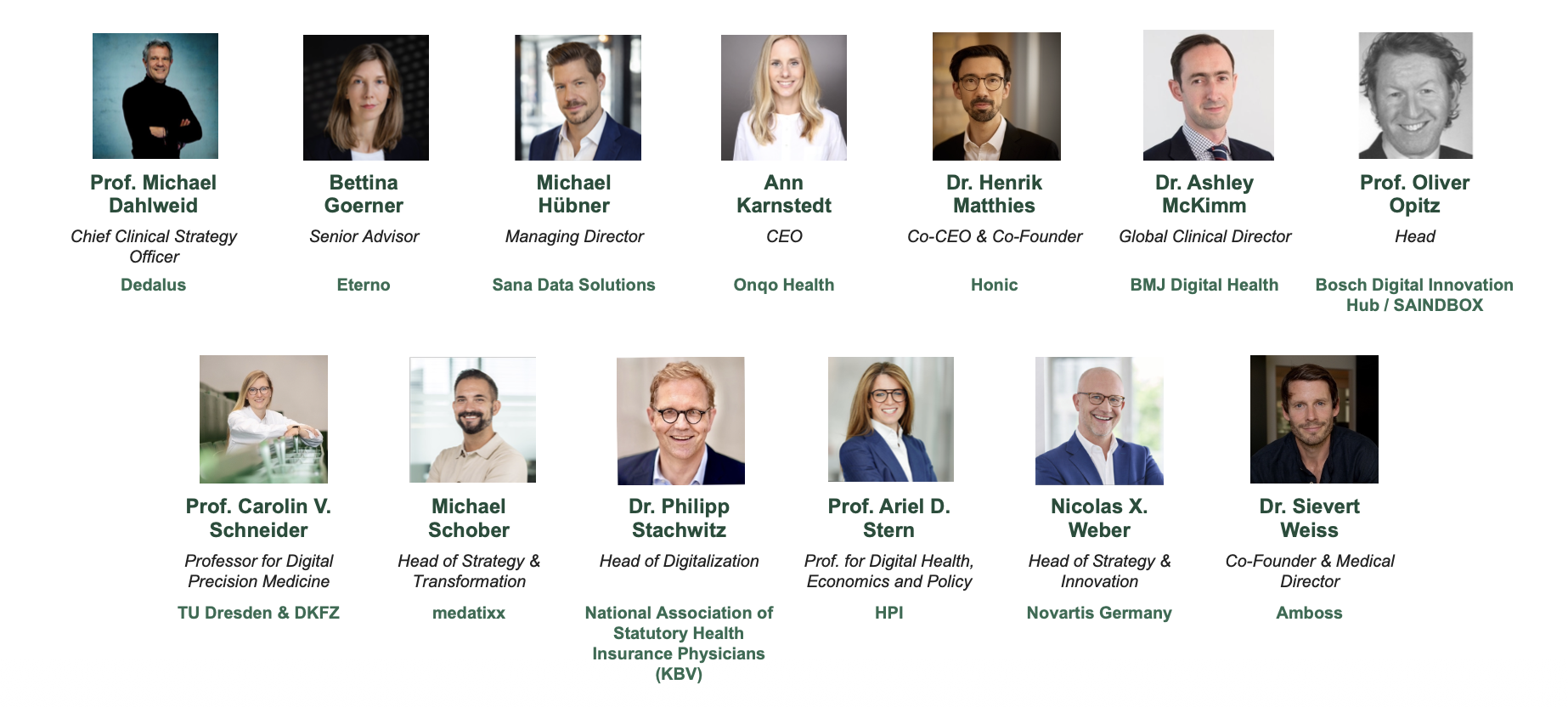
The think tank met for several months to answer one question: how do we get trustworthy Medical AI to the point of care? It brought together healthcare delivery, science, joint self-governance, medical societies and industry. Its 13 members come from hospital IT and clinical software, statutory health insurance physicians, academia, pharma, medical publishing and health data.
For Honic, the subject goes to the core of what we do. Medical AI is only as trustworthy as the data it is built and validated on. Real-world health data closes the loop between evidence and care, from validating AI models to measuring their impact in everyday practice.
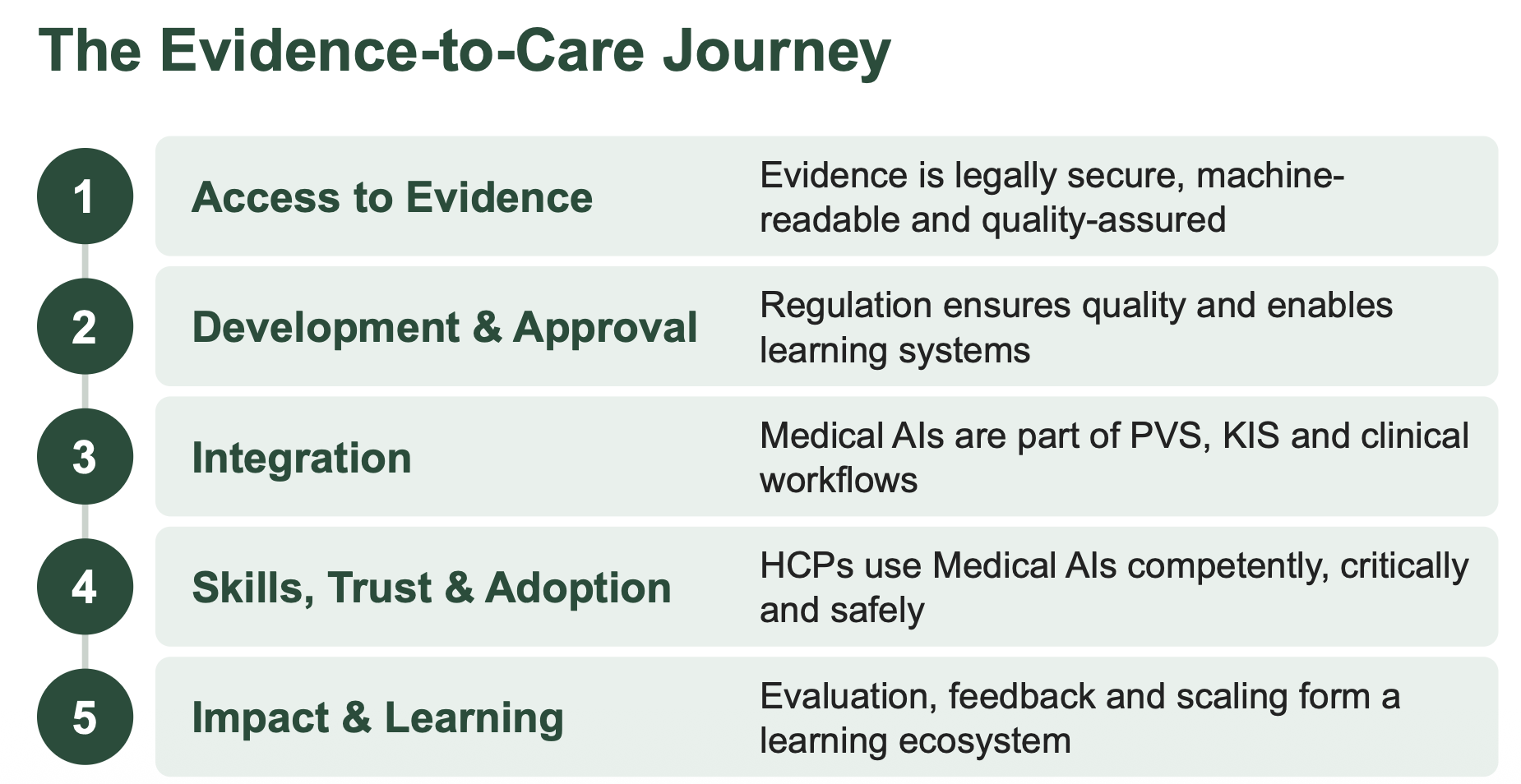
The Evidence-to-Care Journey: 5 phases, 14 recommendations
The whitepaper follows Medical AI along its whole path, from evidence to care. Each phase sets out what good looks like and what needs to happen.
- Make evidence accessible. Evidence should be licensed, fairly remunerated, machine-readable and always up to date.
- Legally secure access to evidence
- Machine-readable, interoperable formats (e.g. FHIR, EHDS metadata)
- Use of care and real-world data, e.g. for AI validation via Honic
- Regulate for learning systems. Regulation should ensure quality and still allow systems to learn.
- AI regulatory sandboxes with "teeth", such as Baden-Württemberg's AI sandbox
- Risk-proportionate approval standards
- Clear rules for controlled updates of learning systems
- Transparency and traceability
- Integrate into practice and hospital systems. Medical AI has to be part of practice management systems (PVS), hospital information systems (KIS) and clinical workflows.
- Open interfaces into core clinical systems, so AI reaches the point where decisions are made
- Scale proven models, such as the medatixx Healthhub
- Build skills and trust. Healthcare professionals should use Medical AI competently, critically and safely.
- AI literacy in medical education, specialist training and continuing education
- Medical societies and self-governance bodies as anchors of trust, building on work such as the Coalition for Medical AI Playbook and the German Medical Association's (BÄK) position paper on AI
- Measure impact. Evaluation, feedback and scaling should form a learning ecosystem.
- Uniform indicators to measure benefit
- Real-world evaluation in everyday care, e.g. the NOHARM study and BMJ Digital Health & AI
- A learning ecosystem, with initiatives such as SPRIN-D Honic Synth
The think tank's core message: introducing Medical AI is not primarily a technological challenge. The tools already exist. What is missing are the right framework conditions.
The German Federal Ministry of Health has set an important impulse with its program for AI regulatory sandboxes in healthcare. Now policymakers, regulators, self-governance bodies, medical societies, healthcare IT vendors and industry need to act together.
In the end, this is not about technology. It is about better decisions for patients, today.
Click here for the German version.