

Use Case: Improving early chronic kidney disease detection through UACR testing in type 2 diabetes patients

Disease
Chronic Kidney Disease

Data user type
Pharmaceutical company

Data source
Lab + EHR

Data frequency
Once delivered

Duration
6 month
Summary

Brief Description
Retrospective real-world evidence study evaluating CKD progression, testing patterns, healthcare utilization, and diagnostic accuracy of UACR versus dipstick testing using linked laboratory and outpatient data.

Public benefit
May improve early CKD detection and risk stratification, supporting better clinical outcomes and more efficient healthcare resource allocation.

Intended use
The data user intended to use the insights o populate relevant parameters of a health economic model aiming to demonstrate the added clinical and health economic benefit of increased UACR testing in the German T2D population.

Number of patients & attributes used
Approximately 4,426 patients with concurrent UACR and eGFR testing derived from >27,000 type 2 diabetes patients.
Attributes included demographics, laboratory data (UACR, dipstick, eGFR), cardiovascular outcomes, mortality, practitioner visits, and medication data.

Data provision
01/2025
Why this study matters

Chronic kidney disease (CKD) is a progressive condition associated with increased cardiovascular risk, reduced quality of life, and elevated mortality. Type 2 diabetes represents one of the most important drivers of CKD development, making early identification of kidney damage in this population critical.
Guidelines recommend routine monitoring of kidney function using estimated glomerular filtration rate (eGFR) alongside urine albumin-to-creatinine ratio (UACR) testing to detect early kidney damage. However, in Germany, testing recommendations and clinical practice remain inconsistent, and dipstick testing is often used despite limitations in diagnostic accuracy.
To address these gaps, we conducted a real-world evidence study aimed at evaluating the role of UACR testing in improving early CKD detection among patients with type 2 diabetes.
Project objective
The study aimed to generate German real-world evidence supporting the clinical value of UACR testing by:
- assessing CKD progression across KDIGO risk categories
- evaluating healthcare resource utilization and testing frequency
- comparing diagnostic accuracy of UACR versus dipstick testing
- quantifying associations between albuminuria, kidney outcomes, cardiovascular events, and mortality
The findings were intended to inform a health-economic model supporting policy discussions on improved CKD screening strategies.

Study design
- This retrospective analysis leveraged aggregated and anonymized longitudinal real-world data covering 2021–2023.
Population
- Adults ≥18 years with type 2 diabetes (ICD-10 E11)
- German patients with valid postal codes
- Availability of concurrent eGFR and UACR measurements
- Minimum 1-year follow-up
The final study population included approximately 4,426 patients with concurrent UACR and eGFR testing, derived from a broader cohort of over 27,000 type 2 diabetes patients.
Key insights
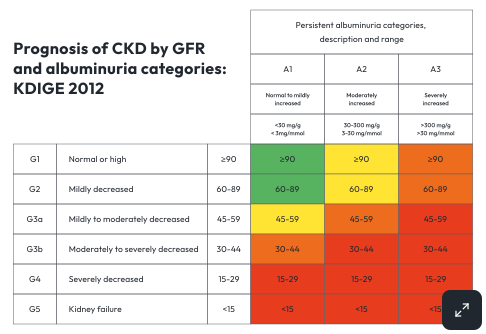
Risk stratification and CKD progression
Real-world data enabled classification of patients across KDIGO risk categories using eGFR and albuminuria, revealing measurable progression patterns over time.
Clinical outcomes
The analysis demonstrated associations between higher KDIGO risk categories and increased mortality and cardiovascular event rates.
Testing patterns
Results indicated variability in testing frequency across KDIGO risk groups and highlighted potential underutilization of albuminuria testing relative to guideline recommendations.
Diagnostic accuracy
Reclassification analyses showed differences between dipstick and UACR testing, supporting the greater sensitivity and clinical utility of quantitative UACR measurements.
Public benefit & Future directions

The study provides robust evidence on CKD detection gaps in routine care and highlights the potential of improved albuminuria testing to support earlier diagnosis and intervention.
These insights may contribute to:
- improved CKD screening strategies
- optimized risk stratification in diabetes populations
- enhanced guideline alignment
- evidence-based policy decision-making
Future work may include:
- expanding population coverage
- evaluating longitudinal treatment effects
- integrating additional care pathway data
- refining health-economic modeling for CKD screening strategies
The project demonstrates how real-world data can inform policy-relevant evidence generation for chronic disease prevention.
Interested in real-world health data research?
Honic supports partners across pharma, academia, and public health in designing and implementing real-world monitoring solutions for cardiovascular risk management.
If you are interested in collaborative research using real-world data, our team is happy to support feasibility assessments, study design, and analytics execution.
Don’t hesitate to contact us to schedule a consultation!

Philipp Hessenberger
VP Growth

Anna Rubinski
Lead analyst of this project